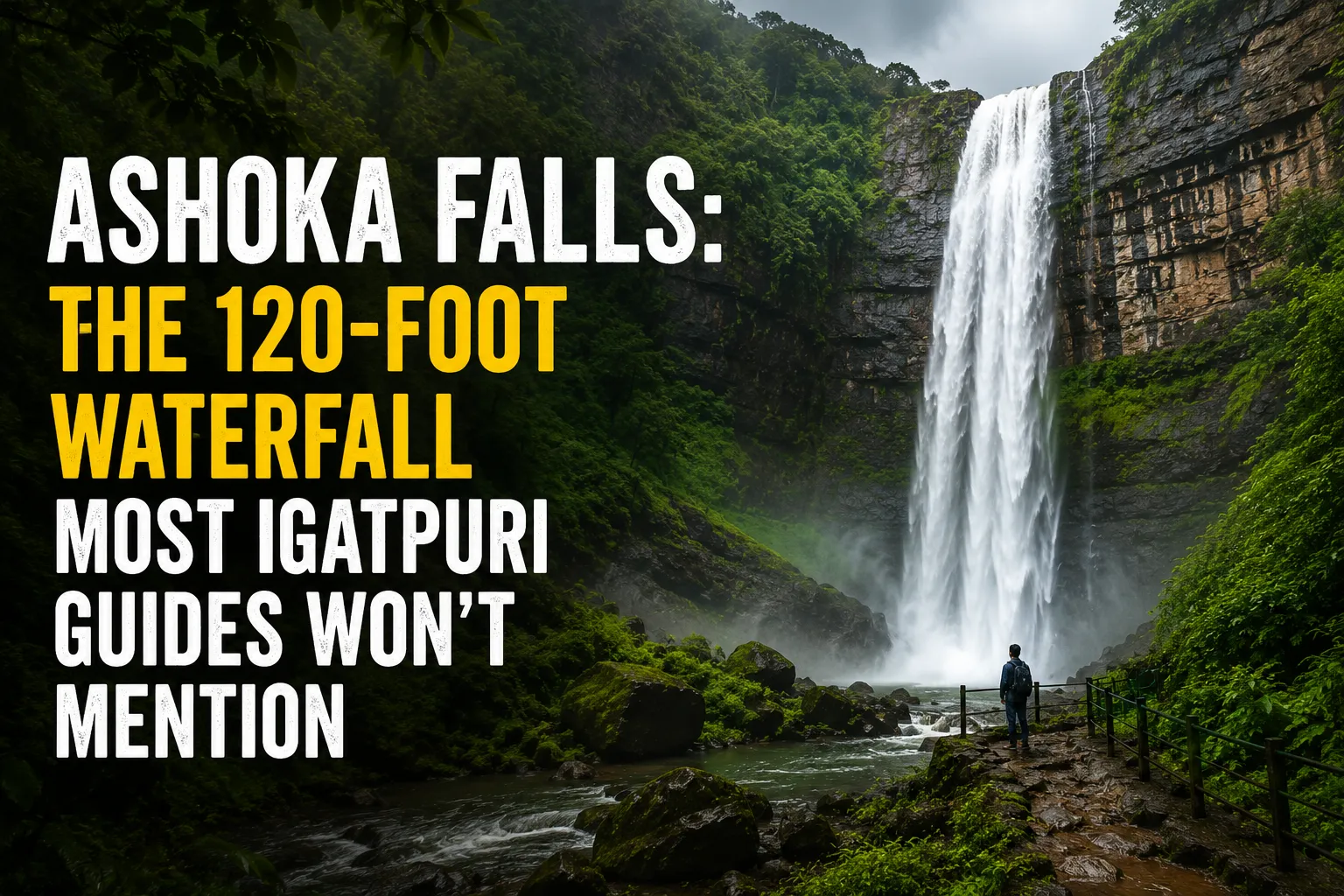
Six kilometres from Vivaant, past the crowds that gather at Camel Valley, Ashoka Falls drops 120 feet through dense Sahyadri forest — quieter, greener, and largely missing from the usual Igatpuri lists.
Every Igatpuri travel list leads with Camel Valley. Fair enough — it earns the hype. But six kilometres from Vivaant Retreat & Conventions, tucked into a fold of the Sahyadri hills that most weekend itineraries skip entirely, is a waterfall that deserves its own headline: Ashoka Falls.
Ashoka Falls drops a clean 120 feet through dense Sahyadri vegetation, and unlike the more Instagrammed spots around Igatpuri, it doesn't come with a queue. If you've done Camel Valley on a previous trip and want to see a different side of this region — quieter, greener, less curated — Ashoka Falls is the detour that makes the return trip worth it.
Where Exactly Is Ashoka Falls?
Ashoka Falls sits roughly 6.3 km from Vivaant, a short drive along roads that wind gently through the hills rather than fight them. That distance matters more than it sounds — Igatpuri's terrain means "nearby" can sometimes mean a bruising ghat drive. Ashoka Falls isn't that. It's close enough for a half-day outing, easy enough that you're not sacrificing your whole itinerary to see it, and remote enough that when you arrive, it still feels like you've found something.
The falls form where a hill stream gathers speed and drops through a break in the rock face, feeding a pool at the base that's cool even when the air outside is thick with monsoon humidity. The setting is classic Western Ghats — for the geology and ecology of the range this waterfall belongs to, the Wikipedia entry on the Western Ghats is a useful primer if you want the bigger picture before you go.
Why Ashoka Falls Deserves a Spot on Your Itinerary
Most people who visit Igatpuri hit two or three "greatest hits" — Camel Valley, the Vipassana Pagoda, maybe Tringalwadi Fort if they're up for a trek. Ashoka Falls rarely makes that shortlist, and that's precisely its appeal.
It's genuinely less crowded. Because Ashoka Falls doesn't show up on every generic "top 10 things to do in Igatpuri" listicle, footfall stays manageable even on a good monsoon weekend. You get the sound of water, not the sound of forty other people photographing it.
The approach is part of the experience. The walk in from the road cuts through thick tree cover — the kind of shaded, green corridor that makes the last stretch of any Sahyadri waterfall trip feel like a small reward in itself.
It photographs differently. Where Camel Valley is wide, open, and panoramic, Ashoka Falls is vertical and enclosed — a single, dramatic drop framed by rock and forest. If your camera roll already has the classic Camel Valley wide shot, Ashoka Falls gives you something that doesn't look like everyone else's Igatpuri post.
Best Time to Visit Ashoka Falls
Ashoka Falls is, unsurprisingly, a monsoon-season specialist. From late June through September, the Sahyadri hills receive heavy, sustained rainfall, and Ashoka Falls goes from a modest trickle to a genuine 120-foot curtain of water. If you're planning around peak flow, this is your window — for a general sense of Maharashtra's monsoon patterns and rainfall timing before you lock in dates, the India Meteorological Department publishes seasonal forecasts worth a quick check.
That said, don't write off Ashoka Falls in the shoulder months. Late September and October still carry residual flow from the retreating monsoon, and the surrounding forest is at its most lush. By deep winter, the falls thin out considerably, so if a full, roaring waterfall is the goal, aim for the July–September stretch.
Getting to Ashoka Falls from Vivaant
Staying at Vivaant puts Ashoka Falls firmly within half-day-trip range. The property sits on NH-3, and from there it's a short, straightforward drive to the falls — no confusing turns, no ghat-road anxiety, just a scenic run through the hills. This is the same ease-of-access that makes the resort itself such a practical base for exploring Igatpuri: you're 2.5 hours from Mumbai on a direct highway, and every attraction in the area — Ashoka Falls included — is a manageable spoke off that same hub.
A few practical notes if you're planning the trip:
Footwear matters. The path to the base of Ashoka Falls can get slippery during monsoon season — proper grip is non-negotiable, not optional.
Go earlier in the day. Light is better for photos before midday, and you'll beat any weekend footfall.
Carry a change of clothes. If you're getting close to the pool at the base, you're getting wet — plan for it.
Combine it with Camel Valley. Since both are within a short drive of each other and of Vivaant, an ambitious day can cover both waterfalls without feeling rushed.
Ashoka Falls vs. Camel Valley: What's the Difference?
Guests staying at Vivaant often ask which waterfall to prioritise if time is tight. Here's the honest breakdown:
Camel Valley is the postcard shot — five waterfalls cascading from a single source, wide-angle, dramatic, and understandably the more famous of the two. It's the spot most people have already seen in someone else's photos before they arrive.
Ashoka Falls is the quieter alternative — a single powerful drop, more enclosed, more intimate, and considerably less photographed. If you only have time for one, Camel Valley is the "must-see." If you're staying two nights or more and want to see a side of Igatpuri that doesn't feel pre-packaged, Ashoka Falls is where you go on day two.
Either way, both are close enough to Vivaant Retreat & Conventions that you're not sacrificing a relaxed pace to see them. That's really the whole pitch for basing yourself here — the Sahyadri's best waterfalls are minutes away, not hours.
What to Do After Ashoka Falls
A morning at Ashoka Falls pairs naturally with an easy afternoon back at the property. After the walk in, the humidity, and the inevitable dampness of getting close to the water, there's a specific kind of relief in coming back to a proper swimming pool and sun deck, a hot meal, and a room with a view of the same hills you just hiked through.
That's the rhythm most guests fall into: mornings out exploring — Ashoka Falls, Camel Valley, the Vipassana Pagoda, or a short trek — and afternoons winding down at the resort. Vivaant's dining leans into fresh, home-style Maharashtrian cooking, which after a humid trek to a waterfall is exactly the kind of meal you want waiting for you.
Other Waterfalls and Viewpoints Worth Combining with Ashoka Falls
If Ashoka Falls has you in waterfall-chasing mode, Igatpuri rewards the effort. Camel Valley remains the headline act, but the wider region — part of the same Sahyadri belt that draws trekkers to Kalsubai, Maharashtra's highest peak — has more to offer than most weekend visitors realise. The Maharashtra Tourism site is a solid resource for cross-checking seasonal accessibility across the region's waterfalls and viewpoints before you build out a longer itinerary. For a broader sense of Igatpuri's place on India's tourism map, Incredible India's listings are worth a browse too.
Practical Tips for Visiting Ashoka Falls
A few things worth knowing before you go:
Monsoon means power, but also risk. The same rains that make Ashoka Falls spectacular also make rocks near the base genuinely slick. Stick to marked paths.
There's no formal entry infrastructure. This isn't a ticketed, railed-off attraction — it's a natural site, so come prepared with water, sturdy shoes, and common sense.
Weekday visits are quieter still. If your stay allows flexibility, a weekday trip to Ashoka Falls all but guarantees you'll have long stretches of it to yourself.
Pair it with a stay that's built for exploring. Because Ashoka Falls, Camel Valley, and Dhamma Giri are all within a short radius, a multi-night stay at Vivaant lets you see all of it without feeling like you're constantly packing and unpacking.
Planning Your Trip to Ashoka Falls
If Ashoka Falls is the reason you're finally making the Igatpuri trip, the logistics are simple. Base yourself somewhere close enough that the falls are a morning outing, not an expedition — that's the whole advantage of staying at a property like Vivaant, positioned right where the highway meets the hills. Check current stay options and rates, factor in a monsoon-season visit if a full 120-foot flow is the goal, and build the rest of your Igatpuri itinerary around it — Camel Valley, Dhamma Giri, and Tringalwadi Fort are all close enough to fit into the same trip.
Ashoka Falls won't show up on every generic Igatpuri list, and that's exactly why it's worth the detour. Six kilometres from Vivaant, a short walk through the trees, and a 120-foot drop waiting at the end of it — sometimes the best part of a trip is the spot nobody else put on their itinerary.
For more on planning the rest of your stay — from wedding and event spaces to the full run of things to do nearby — the Vivaant blog has itinerary guides covering the wider Igatpuri area.