What to do in Igatpuri beyond the Vipassana Pagoda — waterfalls, forts, lakes, and where to stay while you explore.
Every time we told someone we were spending a long weekend in Igatpuri, the response was almost identical: "Oh, the meditation place?" And fair enough — Dhamma Giri, the world's largest Vipassana centre, is what most people know the town for. We'd read about it too, and it was on our list. But by the second day, our list had turned into something else entirely, and we'd already started talking about coming back before we'd even checked out — enough that by the time we got home, we'd bookmarked the rooms page for a longer stay next time.
This is the guide I wish someone had handed us on day one — everything in Igatpuri that isn't the Pagoda, and honestly, gave us more to talk about on the drive home than the meditation centre did. If you're the kind of traveller who books a place based on one landmark and discovers the rest by accident, this is written for you.
Dhamma Giri, Briefly — Because It's Worth Seeing Even If You're Not Staying for the Course
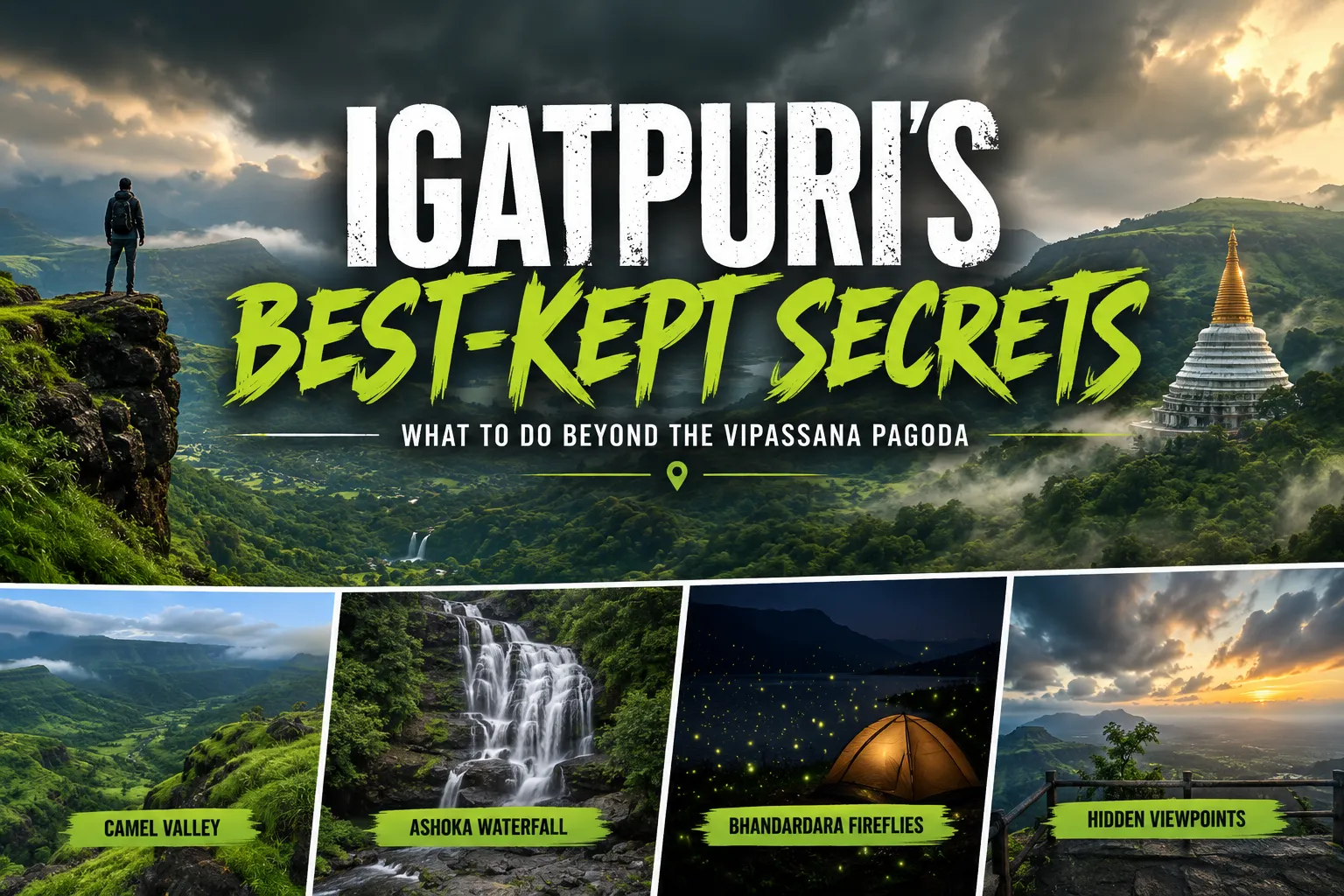
We're not going to pretend Dhamma Giri isn't worth a stop. The Myanmar-style Golden Pagoda gate is striking even from the road, and the centre itself, run under the Vipassana tradition taught globally, draws serious practitioners from every part of the world for its ten-day silent courses. We didn't sign up for a course — that's a real commitment, not a day-trip activity — but we did stop at the gate for photos and a walk around the grounds, and it set a strangely calm tone for the rest of the trip. If you're curious about what actually happens inside a course, it's worth reading up before you go rather than showing up expecting a casual tour; the centre is genuinely a place of practice, not a tourist attraction, and it's treated with more reverence once you understand that.
Even if a course isn't on your list, the grounds themselves are worth a slow half hour — the architecture alone photographs beautifully in the early morning light, before the day's visitors start arriving in larger numbers.
Camel Valley: The Real Photo Stop
Nobody had mentioned Camel Valley to us before the trip, and it ended up being the single best surprise of the weekend. It's a short drive from the property — practically next door — and during the monsoon it turns into a wall of five separate waterfalls dropping off the same ridge into a valley shaped, from the right angle, like a camel's head and hump. We pulled over on the way back from an evening drive and ended up staying almost an hour just watching the light change over the falls. No entry fee, no ticket counter, just a pullout on the highway and one of the best views we had all trip.
What surprised us most was how little planning it needed. We'd expected a viewpoint like this to mean a long detour or a paid entry gate, and instead it was a two-minute stop off the main road with nothing between us and the view but a low railing. If you're short on time and can only add one stop to your itinerary beyond the Pagoda, this is the one we'd tell you to make.
Bhavali Dam and the Quiet Mornings by Igatpuri Lake
If Camel Valley is the dramatic stop, Bhavali Dam and Igatpuri Lake are the quiet ones. We went early one morning, before the mist had fully lifted off the water, and had the entire spot to ourselves except for a few local fishermen. It's not a place with much "to do" in the activity sense — no ziplining, no boat rides that we found — but it's exactly the kind of stop that makes a trip feel unhurried. If your idea of a good holiday morning is a flask of tea and a view, this is where you'll want to be.
We ended up going back a second morning, mostly because the first visit felt too short. There's a small path along part of the dam wall that gives you a different angle on the water, and if you're patient, it's a decent spot for birdwatching once the sun's fully up and the mist has cleared. It's not a destination you build a whole day around, but as a twenty-minute detour on the way to or from somewhere else, it earns its place on the list.
Tringalwadi Fort: A Trek That Doesn't Demand a Full Day
We're not serious trekkers, and we were a little worried Tringalwadi Fort would be more than we'd bargained for. It wasn't. The climb to this 10th-century hill fort takes you up to roughly 3,000 feet, and while it's a real trek — not a paved path — it's manageable for a reasonably fit family without technical gear or a guide. The reward at the top is a full sweep of the Sahyadri range, and on a clear morning you can see for what feels like the whole valley. Budget half a day for it, wear proper shoes, and carry water; there's nothing to buy once you're on the trail.
The kids in our group — nine and twelve — managed it without much complaint, with a couple of rest stops on the way up. If you're travelling with younger children, it's worth starting early in the morning before the heat builds, both for comfort and because the light is better for photos at the top.
Ashoka Falls: The Other Waterfall Worth Chasing
Camel Valley gets most of the attention, but Ashoka Falls, a 120-foot drop a little further from the property, is worth the extra drive if you have a second day free for waterfall-hunting. It's a proper monsoon spectacle, set against dense Sahyadri greenery, and considerably quieter than Camel Valley since it takes slightly more effort to reach. We went on our last morning and had it almost entirely to ourselves — no vendors, no crowds, just the sound of the water and a narrow path down to a viewing spot where you can feel the spray if you get close enough.
Kalsubai Peak: For the One Person in Your Group Who Wants a Real Challenge
We didn't attempt Kalsubai ourselves this trip — it's Maharashtra's highest peak, often called the "Everest of Maharashtra" locally, and it's a genuine full-day trek rather than a casual walk. According to Maharashtra Tourism, the peak sits at roughly 5,400 feet and is one of the most popular trekking destinations in the Sahyadri range, with most groups starting before dawn to reach the summit and get back down before the afternoon heat sets in. It's a short drive from Igatpuri and a common add-on for people staying two or three nights instead of one. We're already talking about it for next time — probably with better shoes and an earlier alarm than we managed this trip.
Where We Stayed, and Why It Made the Rest of the Trip Easier
We based ourselves at Vivaant Retreat & Conventions, right on NH-3, which turned out to matter more than we expected. Every single one of the places above was a short drive from the property, and because there's no ghat-road stretch on the way in from Mumbai, we weren't dealing with the kind of white-knuckle monsoon driving that ruins the first night of a lot of hill-station trips. That's the same point covered in more detail in why Igatpuri makes such a strong weekend case for Mumbai families — the short answer is that a 2.5-hour drive on a proper highway beats a shorter drive on a bad one, every time.
We stayed in a Valley Deluxe room for the first two nights — balcony, decent space for the four of us, comfortable enough that we didn't feel like we were living out of suitcases. When my in-laws joined for the last night, we moved into a Sahyadri Suite, which gave everyone their own space with the two separate rooms and two balconies. Both room types are on the property's rooms page if you want to see what fits your own group.
Meals were a highlight we hadn't expected going in. The in-house restaurant serves a solid mix of Maharashtrian dishes and everyday comfort food, and after a day out at Tringalwadi or Camel Valley, sitting down to a proper thali with the hills going dark outside was exactly what the day needed. Breakfast came included with the stay, which mattered more than we expected on the mornings we left early for Bhavali Dam — nobody wanted to hunt for a roadside stall at 6 AM, and we didn't have to. Details on the dining setup are worth a look if food is part of what you're planning around.
When to Go
We went in the thick of monsoon, which is when Camel Valley and Ashoka Falls are at their most dramatic, but it does mean planning around rain and slippery trails on treks like Tringalwadi. If you'd rather trade the waterfalls for clearer skies and easier trekking conditions, the property's own guide to the best time to visit Igatpuri lays out how the town changes across seasons, which helped us figure out that our next trip is probably a winter one — clearer views from Tringalwadi, easier footing everywhere, and a real shot at attempting Kalsubai without worrying about slick rock on the way up.
A Practical Note Before You Plan Your Own Trip
A quick flag, since this reads like a personal account (because it is one): this is our own experience, written up for the blog, not a review posted on a booking platform. If you're the kind of traveller who cross-checks a place on Google or TripAdvisor before booking, you'll find plenty of guest reviews there in guests' own words — this piece is meant as a fuller trip guide rather than a star rating, and it's worth treating it that way rather than copying it elsewhere as a testimonial.
Planning Your Own Igatpuri Weekend
If the Pagoda was the reason you first looked up Igatpuri, let this be the reason you stay an extra day. Between Camel Valley, Bhavali Dam, Tringalwadi Fort, and Ashoka Falls, we didn't run out of things to do — we ran out of time. What started as a two-night trip built around one landmark turned into a list of five more places we're already planning to revisit, and a strong feeling that one weekend wasn't nearly enough. For anyone curious about the wider area before booking, the property's Igatpuri guide covers most of what's nearby in one place.
Planning your own escape? Check availability at Vivaant Retreat & Conventions →
Whichever season you pick, the Pagoda is still worth the stop — just don't let it be the only thing on your list.