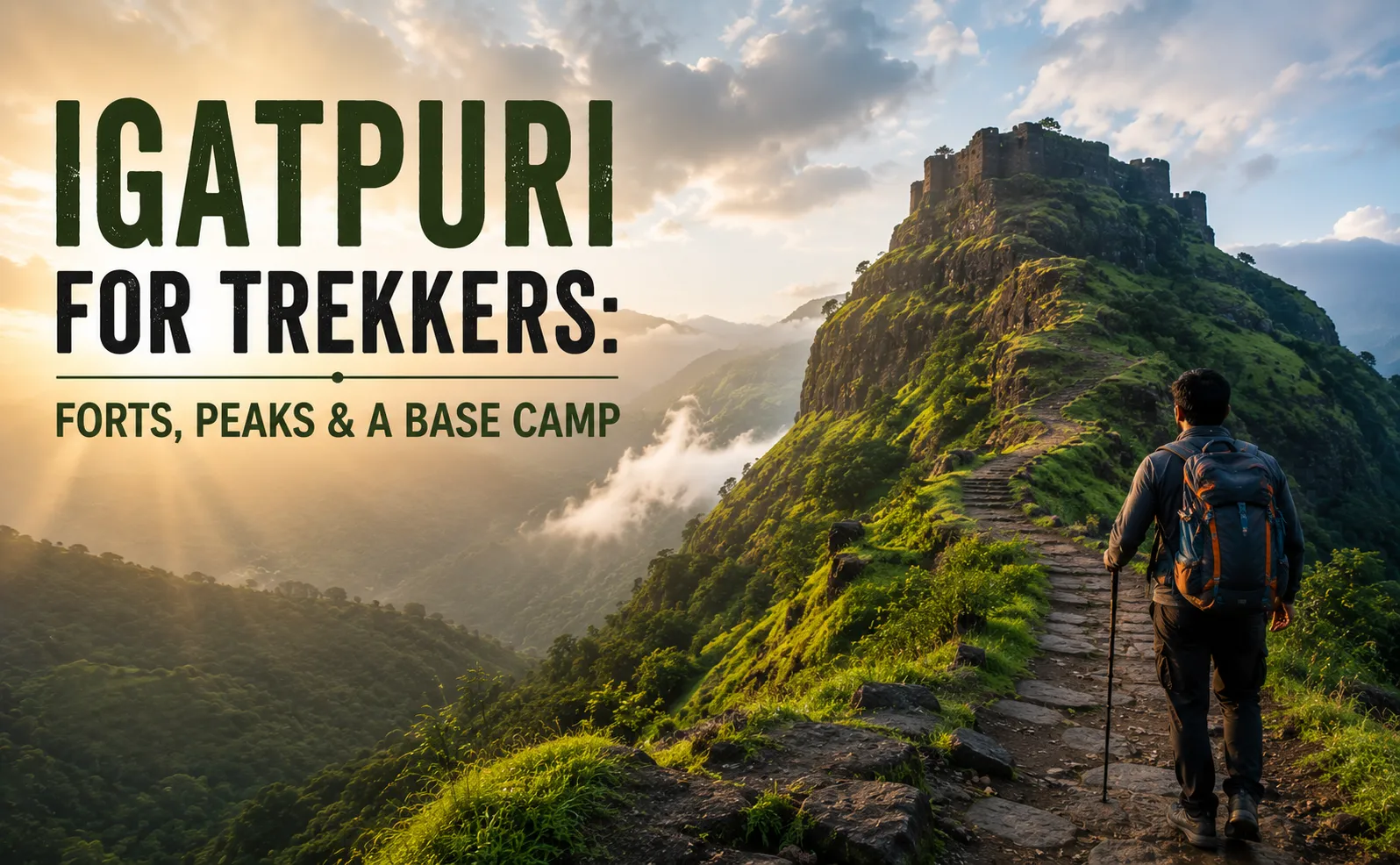
Kalsubai, Ratangad, Harishchandragad — the forts and peaks around Igatpuri make for one of the most rewarding trekking weekends near Mumbai. Here's what makes a proper base camp, and why the pool matters as much as the summit.
There's a moment on the way down from Kalsubai, somewhere past the last iron ladder, when your legs stop negotiating and start complaining outright. That's usually when trekkers start talking about what's for dinner and whether there's hot water where they're staying. It's a fair question. A trek is only half the trip — the other half is what happens after you're back at the base, and that's where most plans near Igatpuri fall apart. This is a guide to doing both halves properly: the forts and peaks, and the resort for trekkers near Igatpuri that actually earns its place in the itinerary.
The Forts and Peaks Worth the Climb
Igatpuri sits at the edge of a trekking belt that most Mumbai weekenders drive straight past on their way to the town's waterfalls. That's their loss. Kalsubai, Maharashtra's highest peak at 1,646 metres, is a 5-6 km climb from Bari village that rewards patience more than speed — the trail winds through open grassland before a final push up iron rungs bolted into the rock, and on a clear morning the summit looks out over the entire Bhandardara basin.
A short distance further, Ratangad offers a different kind of climb altogether. This roughly 400-year-old fort, once favoured by Chhatrapati Shivaji Maharaj, is built around a natural rock formation called the Eye of the Needle, with two cave systems near the top that trekkers still use to camp overnight. The base village, Ratanwadi, also holds the centuries-old Amruteshwar Temple — worth the walk even if you're not climbing that day.
For trekkers who want more than a day trip, Harishchandragad rounds out the trio — a longer, tougher climb within the same wildlife sanctuary belt, with rock-cut caves and a cliff face that draws serious groups rather than casual weekenders. Together, these three make Igatpuri one of the more complete trekking bases within reach of Mumbai, and knowing which trail suits your group is half the planning.
What a Real Base Camp Looks Like
Most of what makes or breaks a trekking weekend has nothing to do with the trail. It's whether your room is close enough to the trailhead that you're not losing two hours to travel before sunrise. It's whether there's hot water and real food waiting when you're back, muddy and running on nothing but the granola bar you packed at 5 a.m. It's whether the drive out doesn't add a ghat section to an already long day.
Vivaant Retreat & Conventions sits on NH-3 in Talegaon, close enough to both the Kalsubai and Ratangad trailheads that you're not sacrificing your morning to the drive, and flat enough on the approach that a pre-dawn start doesn't mean navigating hill roads in the dark. The property's Valley Deluxe and Sahyadri Suite both face the same range you'll be climbing, so the view doesn't end when the trek does — you get to look back at where you've been.
And then there's the pool. It sounds like a small thing until you're standing in it the evening after a six-hour trek, legs finally still, watching the same hills you climbed that morning turn a different colour as the light drops. It's not a substitute for the climb. It's the part of the plan that makes you want to come back and do another one.
The Rest of the Weekend
A resort for trekkers near Igatpuri only works if it holds up outside the trail too. Vivaant's dining means you're not driving into a small hill town after dark looking for something open — the food is there when you get back, however late the descent runs. If your group wants to stretch the weekend beyond a single summit, our guide to the Kalsubai and Ratangad trails breaks down distances and the best season for each, and Camel Valley makes an easy, gentler add-on the next morning for anyone whose legs have had enough of climbing.
For trail-specific planning, IndiaHikes' documented Kalsubai route and Ratangad trek page are dependable references, and the Maharashtra Tourism department's Kalsubai listing covers official access points. If you're weighing a monsoon attempt, check the India Meteorological Department's forecast before you commit to a date — conditions on these trails shift faster than the city forecast suggests. For background on the region's fort history, Wikipedia's entry on Ratangad is a solid starting point.
Book the Base, Then Plan the Climb
The forts and peaks around Igatpuri aren't going anywhere, and neither is the appeal of coming back to a proper room, a hot meal, and a pool instead of a long, tired drive home. Pick your trail, then book your stay at Vivaant Retreat & Conventions — the resort for trekkers near Igatpuri built for exactly this kind of weekend.
Timing matters more than most first-time trekkers realise. Kalsubai and Ratangad are both best attempted between October and February, once the monsoon grass has dried and the iron rungs aren't slick with runoff — a July or August attempt on either trail is a different, riskier proposition entirely. Winter mornings near Igatpuri also bring a chill that catches people off guard; a pre-dawn start at the Bari base village can mean single-digit temperatures before the sun clears the ridge, so packing for the summit, not just the drive up, is worth the extra five minutes.
Groups tend to underestimate logistics as much as difficulty. A Kalsubai attempt with more than six or seven people needs a realistic plan for staggered pacing — the iron ladder sections near the top become a bottleneck fast, and nobody wants to be queuing on a rock face as the light starts to go. That's another reason the base matters as much as the base camp: leaving from a property that's 2.5 hours out on NH-3, without a ghat section eating into the schedule, buys back exactly the margin a larger group needs to summit and descend before dark.