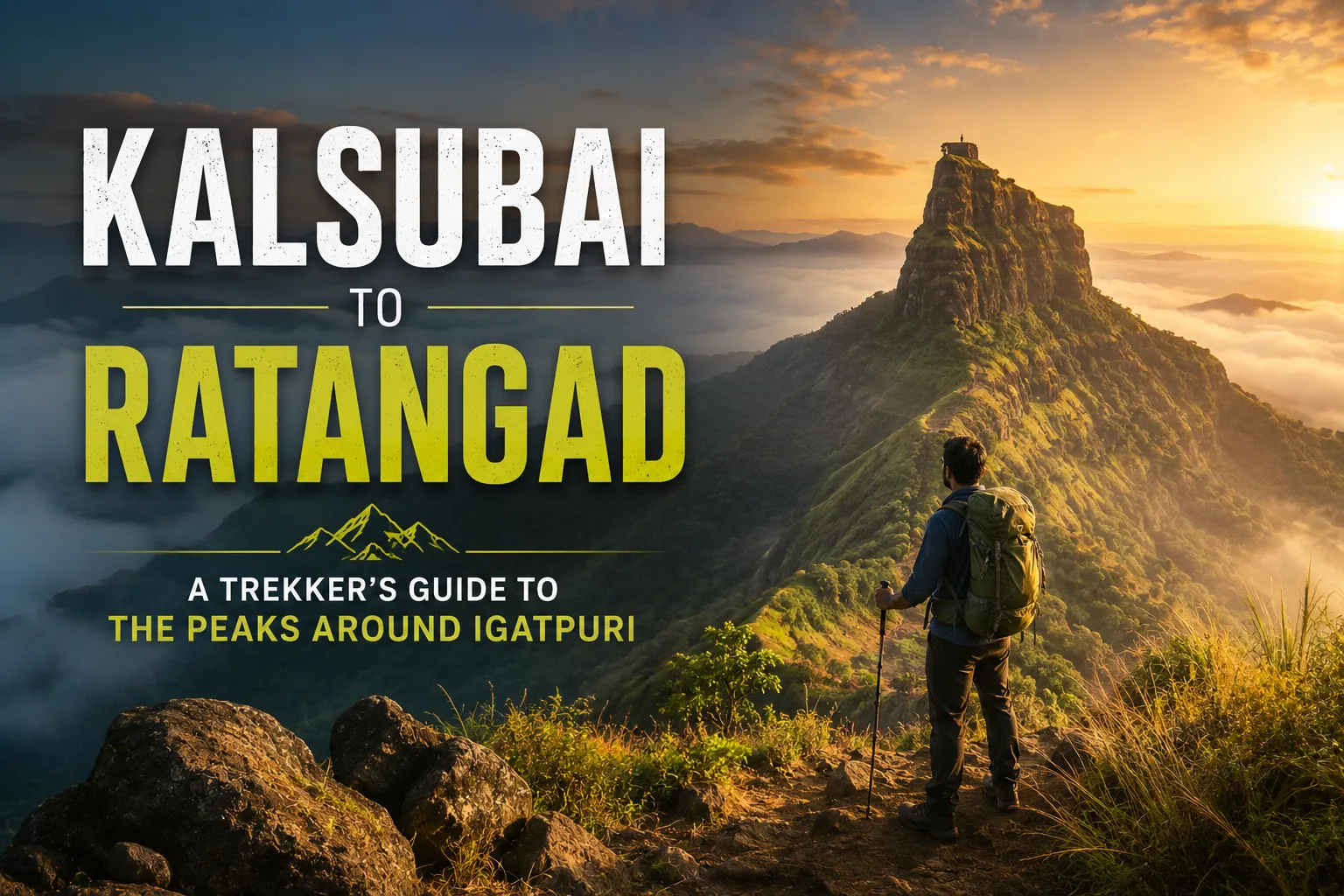
Two of Maharashtra's most rewarding climbs — Kalsubai, the state's highest peak, and Ratangad, the historic "Jewel of the Sahyadris" — sit right on Igatpuri's doorstep. Here's the complete trekker's guide: trail distances, best season, what to pack, and where to rest after at Vivaant Retreat.
If you've ever stood on the Igatpuri-Kasara stretch of the Mumbai-Nashik highway and looked west, you've already seen them — a jagged wall of basalt rising out of the Western Ghats, half-hidden in cloud for half the year. The peaks around Igatpuri are some of the most rewarding trekking terrain in Maharashtra, and yet most weekend travelers never get past the town's waterfalls and viewpoints. This guide is for the ones who want to go higher.
We're covering the two anchor treks of the region — Kalsubai, Maharashtra's highest point, and Ratangad, the Sahyadris' most storied hill fort — along with what it takes to combine them, when to go, and where to recover afterward. If you're planning a trip to the peaks around Igatpuri, here's everything you need before you lace up your boots.
Why Igatpuri Is the Right Base for These Treks
Igatpuri sits at the edge of the Kasara ghat, roughly two and a half hours from Mumbai on NH-3, and it's the last major town before the terrain climbs into the Kalsubai-Harishchandragad Wildlife Sanctuary. Nearly every trekking outfit that runs trips into this belt routes trekkers through Igatpuri, either by rail or road, before the final stretch to the base villages. That makes it the natural staging point for anyone tackling the peaks around Igatpuri — you get a full night's rest, hot food, and a proper bed before the climb, instead of starting cold from Mumbai at 4 a.m.
This is where a stay at Vivaant Retreat & Conventions earns its keep. The property sits right on NH-3 in Talegaon, close enough to the highway that reaching either base village doesn't eat into your trekking day, but far enough into the hills that the mornings are properly cool and quiet.
Kalsubai: The Highest of the Peaks Around Igatpuri
Kalsubai is the headline trek in this belt for a reason. At 1,646 metres (5,400 feet), it's the tallest point in Maharashtra, and on a clear day the summit gives you a 360-degree view over the entire Bhandardara basin. The trek starts at Bari village, roughly 33-35 km from Igatpuri by road, and the climb itself is about 5.5-6 km one way, taking three to four hours at a comfortable pace.
It's graded easy to moderate — steep in sections, with iron ladders bolted into the rock face near the top, but manageable for a reasonably fit beginner. A small temple dedicated to the local deity Kalsubai sits partway up, and a second one at the summit; the Navratri season in particular draws large numbers of pilgrims alongside trekkers. Outside festival weekends, though, the trail is peaceful, and mornings especially reward you with layers of mist sitting in the valleys below — one of the defining images of the peaks around Igatpuri.
Most trekkers do Kalsubai as a day trip, starting from Bari before sunrise and descending by early afternoon. It's also the trek that pairs most naturally with an overnight stay back at the resort — you're on the trail before dawn and back in a hot shower and a proper meal by evening, at Vivaant's in-house dining.
Ratangad: The Jewel of the Sahyadris
If Kalsubai is about altitude, Ratangad is about history. This roughly 400-year-old hill fort — once among Chhatrapati Shivaji Maharaj's favoured strongholds — sits at 1,297 metres (4,255 feet) above Bhandardara Lake, on the boundary of the Ahmednagar and Thane districts. The base village is Ratanwadi, reachable via Shendi from the Igatpuri side, and the climb from there is a moderate 3-4 hour trek through forest and open fields.
The fort's signature feature is the "Nedhe," or Eye of the Needle — a natural rock formation with a hole punched clean through it, framing the valley beyond. Ratangad also has two cave systems near the summit that trekkers use for overnight stays, and a working water cistern that makes it one of the more forgiving forts for a longer trip. At the base, the roughly 1,000-year-old Amruteshwar Temple, carved in the Hemadpanti style, is worth the detour on its own.
Ratangad is further from Igatpuri than Kalsubai — around 56 km by road — which makes it a longer day, or better suited to an overnight camp if your group is up for it. It's one of the quieter peaks around Igatpuri, in the sense that it draws serious trekkers rather than day-trip crowds, and the fort's scale means you rarely feel boxed in even when other groups are on the trail.
Combining the Two
Seasoned trekkers in this region often treat Kalsubai and Ratangad as a two-peak weekend rather than separate trips, since both base villages sit within the same Bhandardara pocket and can be linked by road or a shared jeep. A typical plan looks like this:
Day 1: Early departure from your stay near Igatpuri, summit Kalsubai by late morning, descend, and transfer toward Ratanwadi by evening.
Day 2: Trek Ratangad at a relaxed pace, explore the Amruteshwar Temple and the Eye of the Needle, and head back to base by afternoon.
It's an ambitious two days, but it's the most efficient way to cover both major peaks around Igatpuri without repeating the long drive out from Mumbai twice. If your group isn't up for back-to-back climbs, splitting them across two separate weekends works just as well — and gives you a reason to come back.
Best Time to Trek
The window for these treks runs from just after the monsoon through winter — roughly October to February. Post-monsoon (October-November), the hills are still green and waterfalls are running, though trails can be slippery. Winter (December-February) brings the clearest skies and the best long-range visibility from the summits, along with cooler daytime trekking temperatures. Monsoon treks (June-September) are possible and popular for their dramatic cloud cover, but they demand more caution — the rock faces on both Kalsubai and Ratangad get slick, and visibility at the top can drop to near zero without warning. Trekkers planning a monsoon attempt should check the India Meteorological Department forecast before setting out, since conditions in this belt can shift fast.
What to Pack
Sturdy trekking shoes with grip — sandals or sneakers aren't enough on either trail
2-3 litres of water per person; there are limited reliable sources on both routes
A basic first-aid kit and a headlamp if you're starting before sunrise
Light rain protection outside peak winter months
Cash — most base village stalls and jeep operators don't take cards
Where to Rest After
Both treks are physically demanding enough that the day after matters as much as the day itself. This is where staying near Igatpuri rather than pushing straight back to Mumbai pays off. A night at Vivaant Retreat & Conventions gives you a proper bed, a pool to ease out sore legs, and a kitchen that doesn't shut down the moment you arrive late and dusty from the trail. It's also a good staging point if you're combining a trek with some of the region's gentler attractions — the resort's own guide to Camel Valley and its roundup of Igatpuri's lesser-known spots are both worth a look if you're building out a longer itinerary around the trek.
For trekking-specific trail notes, elevation data, and route maps, IndiaHikes' documented Kalsubai trek and its companion Ratangad trek page are reliable references, and the Maharashtra Tourism department's page on Kalsubai has official access details. For the fort's history, Wikipedia's entry on Ratangad is a useful starting point.
Final Word
The peaks around Igatpuri don't get the same attention as the town's waterfalls and the Vipassana Pagoda, but for trekkers willing to put in the climb, they're the real draw of this corner of the Sahyadris. Whether you take on Kalsubai alone, add Ratangad for a full weekend, or use one as a warm-up for the other, Igatpuri remains the smartest place to base yourself — close enough to the trailheads to save you hours, and comfortable enough that you'll actually want to come back and do it again. If you're plotting a trekking weekend around the peaks around Igatpuri, book your stay at Vivaant and let the hills do the rest.